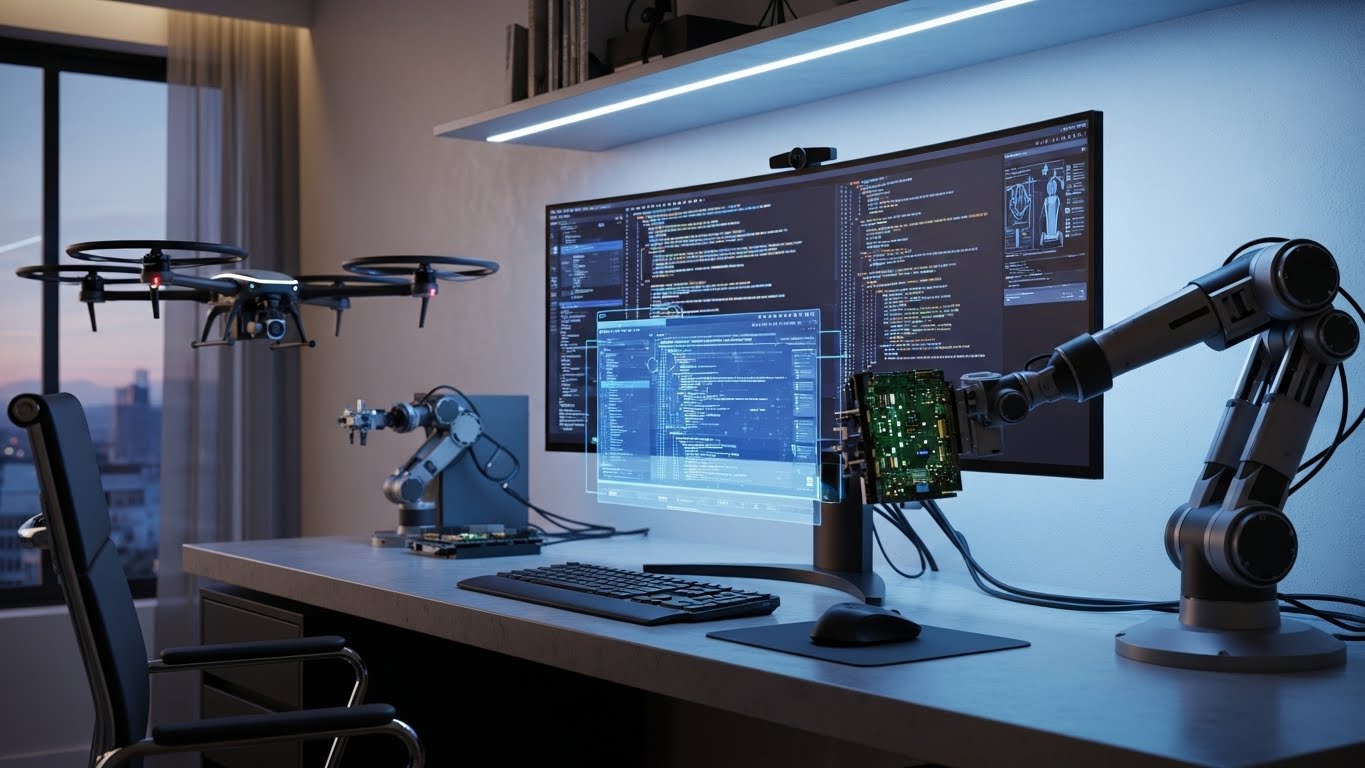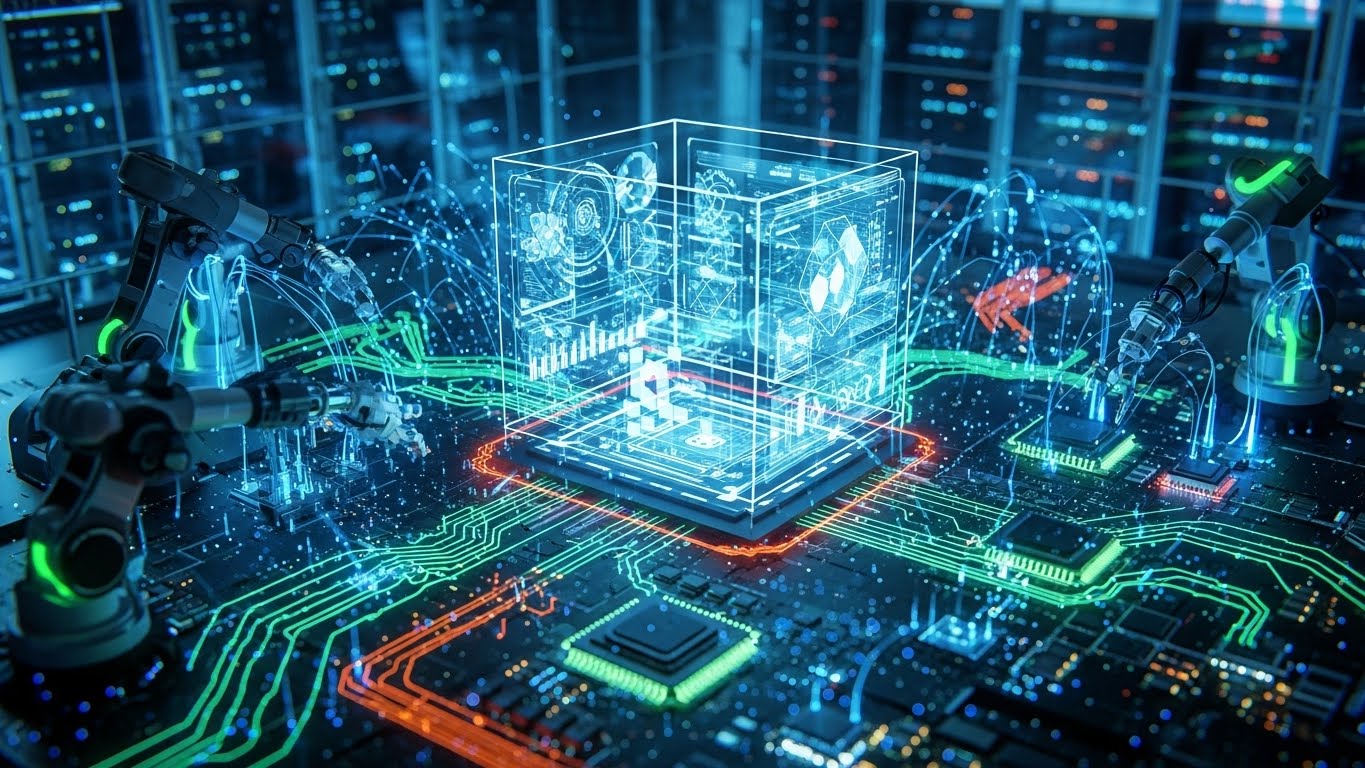
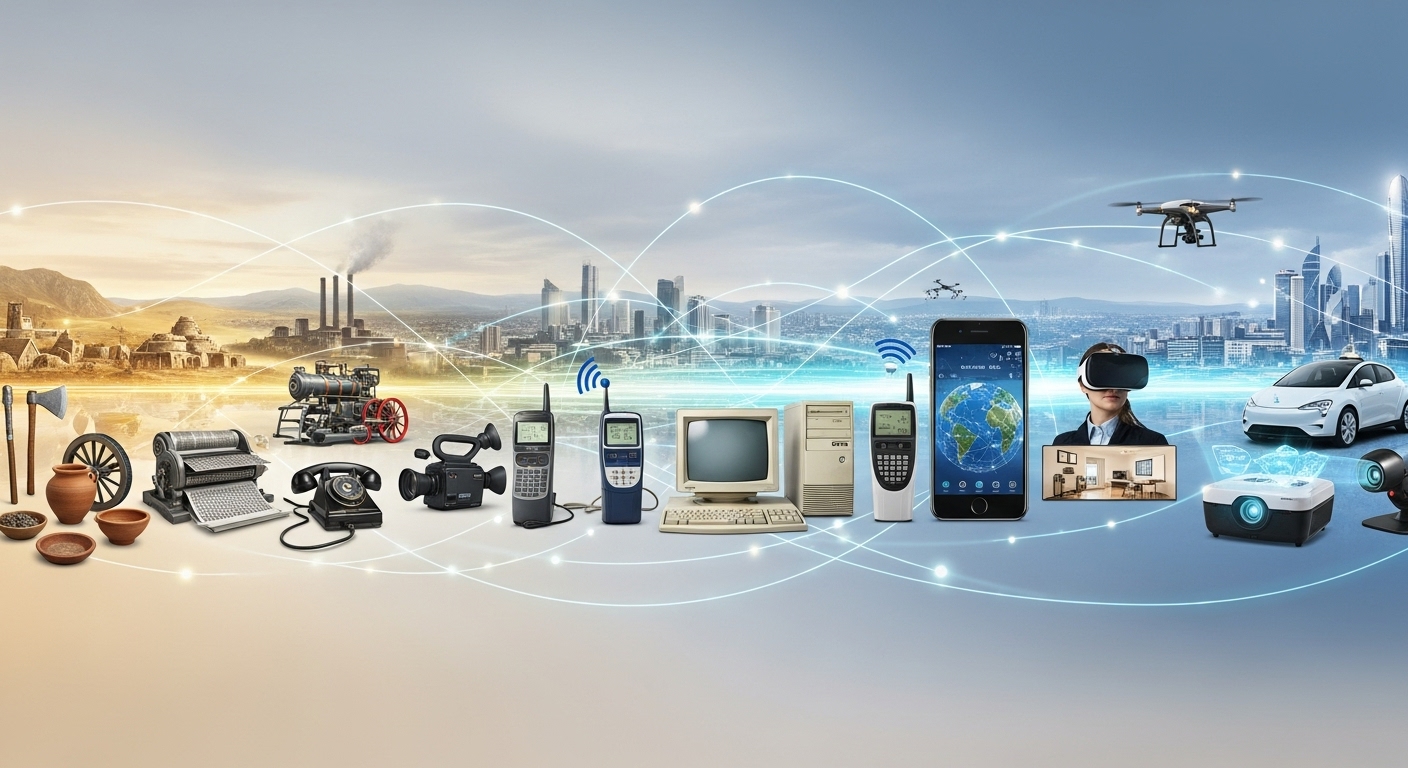
Technology is not merely a tool; it is the defining feature of human civilization. From the first spark of fire to the rise of artificial intelligence, every era of humanity has been marked by the technologies it created and mastered. The twenty-first century, however, has accelerated this evolution to an unimaginable speed. Innovations that once took decades now appear within years, reshaping how we live, work, communicate, and even think. This blog explores the journey of technology — its roots, its transformation, and its profound influence on every aspect of life — as well as where it might lead us next.
The Dawn of Technology: From Survival Tools to Civilization
The story of technology begins long before electricity or microchips. It begins with survival. The earliest humans learned to shape stones into blades and spears, not because they sought progress, but because necessity demanded it. Fire, the wheel, and basic agriculture followed — each invention multiplying human power and altering the relationship between humans and nature.
These early technologies were simple by modern standards, yet revolutionary for their time. Fire extended the day into night and allowed for cooked food, making nutrients more digestible. The wheel enabled trade and transport, expanding societies beyond isolated villages. Metalworking created tools and weapons that built empires. In every stage, technology served as both a product of human intelligence and a catalyst for more complex societies.
The Industrial Revolution: Machines That Changed Everything
The true acceleration of technological progress began with the Industrial Revolution in the late eighteenth century. Steam engines powered factories, locomotives, and ships, ushering in an age of mass production and global trade. Human and animal labor were gradually replaced by mechanical systems capable of working tirelessly. Cities swelled as people moved from farms to factories, and with them came the birth of modern industrial economies.
This era was also the birthplace of modern science and engineering as organized disciplines. Innovators like James Watt, George Stephenson, and later Thomas Edison embodied a new kind of inventor — one who combined scientific understanding with mechanical creativity. Electricity replaced steam as the dominant source of energy, leading to inventions such as the light bulb, telegraph, and telephone. By the end of the nineteenth century, communication and production had reached scales previously unimaginable.
But industrial progress also came with challenges. Pollution, worker exploitation, and class divides emerged as darker sides of technological change. Yet these problems also inspired new social and political movements, leading to the first serious conversations about how technology should serve humanity — not dominate it.
The Digital Revolution: From Machines to Information
While the Industrial Revolution mechanized the body, the Digital Revolution mechanized the mind. The twentieth century introduced technologies that could process, store, and transmit information — transforming how humans think, learn, and interact. The birth of the computer in the mid-1900s marked one of humanity’s most pivotal moments.
Early computers like ENIAC filled entire rooms and could only perform simple calculations. Yet within decades, microchips and transistors miniaturized these machines, making them accessible to businesses, schools, and eventually homes. The personal computer redefined the workplace and education, empowering individuals to perform tasks once reserved for large institutions.
Then came the internet — the invisible network that connected the world. It began as a military project and evolved into a global system that allowed information to flow freely across continents. Email replaced letters, digital libraries replaced encyclopedias, and social networks replaced town squares. The human experience, once limited by geography, became truly global.
The digital age was not merely about technology but about transformation. Data became the new oil, and knowledge became power. The computer did not just store facts; it became an extension of human consciousness.
The Rise of the Mobile Era: Computing in Your Pocket
The early 2000s witnessed another massive leap: the rise of mobile technology. The invention of the smartphone condensed the power of a computer, camera, music player, and telephone into a single device small enough to fit in a pocket. It changed everything — communication, entertainment, navigation, commerce, and even relationships.
The smartphone symbolized the merging of hardware and software in the most intimate way. It was no longer just a machine; it became a companion. People carried it everywhere, using it to manage nearly every aspect of their lives — from banking to dating, from health tracking to education.
Mobile apps revolutionized industries. Taxi services became ride-sharing platforms. Retail turned into e-commerce. Music and films migrated from physical media to digital streaming. The smartphone became the center of the digital universe, connecting individuals to vast ecosystems of information and services.
Yet this newfound convenience came with consequences. The constant connectivity blurred the boundaries between work and life. Attention spans shortened, and digital addiction became a real concern. Technology had become both empowering and consuming — a dual force that shaped not only behavior but also identity.
Artificial Intelligence: Machines That Learn
Among all modern technologies, artificial intelligence stands as the most transformative. AI represents a new frontier in which machines are not merely tools but entities capable of learning, reasoning, and making decisions. From search engines to self-driving cars, AI is now embedded in nearly every digital experience.
The foundations of AI lie in the mid-twentieth century, when computer scientists sought to create systems that could mimic human thinking. Early programs could play chess or solve simple problems, but true learning emerged only with the rise of machine learning — algorithms that could improve themselves through data.
Today, AI systems can analyze medical scans more accurately than doctors, translate languages instantly, compose music, and even generate art and text. They power recommendation engines, virtual assistants, and predictive analytics used in every major industry. In short, AI has made data not just useful but intelligent.
However, this intelligence raises complex questions. What happens when machines outperform humans in critical tasks? How do we ensure fairness, accountability, and ethics in systems that can influence millions of lives? The debate around AI is not just technological but philosophical — touching on the nature of consciousness, creativity, and what it means to be human.
The Cloud and Big Data: The Invisible Infrastructure
While visible technologies like smartphones and robots capture attention, the true engine of modern innovation lies in invisible infrastructure — the cloud and big data. The cloud refers to vast networks of servers distributed around the globe that store and process information remotely. Instead of keeping files on local machines, users can access them anywhere, anytime.
This architecture enabled the explosion of data-driven services. Every click, search, purchase, and interaction generates data. Analyzing this information gives businesses and governments insights into behavior, preferences, and trends at unprecedented scales. Big data has become the backbone of modern decision-making — guiding everything from healthcare research to financial forecasting.
Yet this abundance of information also raises issues of privacy and control. Who owns the data we generate? How is it used, and by whom? As companies and governments build increasingly detailed profiles of individuals, the balance between convenience and surveillance becomes more delicate than ever.
The Internet of Things: A Connected World
If the internet connected people, the Internet of Things (IoT) connected everything else. IoT refers to the integration of sensors, chips, and connectivity into everyday objects — turning them into “smart” devices that can communicate with each other and with us. From refrigerators that order groceries to thermostats that learn our habits, IoT is weaving intelligence into the fabric of daily life.
This technology extends far beyond homes. In agriculture, sensors monitor soil and weather to optimize crop yields. In cities, smart traffic systems reduce congestion and pollution. In healthcare, wearable devices track vital signs and alert doctors in real time. The result is an ecosystem of constant data exchange — a living, breathing digital organism that surrounds humanity.
The promise of IoT lies in its ability to make life more efficient, sustainable, and responsive. Yet its challenges mirror those of every connected system: security, reliability, and the ethical handling of data. As more devices come online, the need for robust cybersecurity becomes paramount.
Biotechnology and Human Enhancement
Technology’s influence no longer stops at machines; it extends into the human body itself. Biotechnology — the fusion of biology and technology — is reshaping medicine, agriculture, and even the definition of life. Genetic engineering allows scientists to modify DNA, curing diseases and improving crop resistance. Prosthetics and implants restore mobility and senses. Brain-computer interfaces promise to merge human thought with digital systems.
The implications are staggering. Diseases once considered incurable are now treatable through gene therapy. Artificial organs and tissues are being grown in laboratories. Neural implants could one day restore memory or enhance intelligence. Humanity is approaching an era where technology and biology are indistinguishable — where evolution becomes programmable.
Yet as with every frontier, ethical dilemmas arise. Who decides how far human enhancement should go? What happens when genetic modification becomes a tool of inequality? As technology gives us power over life itself, the need for moral reflection becomes more urgent than ever.
Renewable Energy and the Quest for Sustainability
One of the greatest challenges of modern civilization is balancing progress with planetary health. The same technologies that fuel growth also contribute to climate change and resource depletion. Fortunately, technology also provides the means to address these problems.
Renewable energy systems such as solar, wind, and hydropower are transforming the global energy landscape. Advances in battery technology and smart grids are making clean energy more reliable and accessible. Electric vehicles are reducing dependence on fossil fuels, while sustainable materials and circular economies aim to reduce waste.
The integration of artificial intelligence in energy systems further enhances efficiency. Smart algorithms predict consumption patterns, optimize distribution, and reduce emissions. Technology, once seen as a threat to nature, is now a critical tool for its preservation. The path to sustainability will not be easy, but innovation gives humanity its best chance.
The Metaverse and the Future of Digital Reality
Beyond the screen lies another frontier — the metaverse. This emerging concept envisions a fully immersive digital world where people can work, play, and interact using virtual and augmented reality. Unlike traditional social media, the metaverse aims to create shared, persistent environments that feel as real as the physical world.
Virtual reality headsets and augmented reality glasses are becoming more sophisticated, offering experiences that blur the boundaries between real and digital. In the metaverse, architecture, commerce, and even identity are reinvented. People can attend concerts, collaborate on projects, or explore virtual worlds — all from their homes.
While still in its infancy, the metaverse represents the next stage of human-computer interaction. It could redefine education, entertainment, and communication, offering new dimensions of creativity. Yet it also raises questions about escapism, digital ownership, and social inequality. As virtual spaces grow, the challenge will be ensuring they enrich rather than replace reality.
The Ethics of Innovation: Responsibility in a Connected World
Technology’s power comes with responsibility. Every innovation, from the steam engine to artificial intelligence, carries consequences — both intended and unintended. Ethical reflection must accompany technical progress if society is to benefit fully.
Privacy, fairness, accessibility, and environmental impact are central concerns in modern technology. Algorithms can reinforce bias, data collection can violate privacy, and automation can displace jobs. Developers, policymakers, and users all share the duty of shaping technology that uplifts humanity rather than dividing it.
Ethical technology is not merely about avoiding harm; it is about designing systems that promote human flourishing. This requires transparency, accountability, and empathy — qualities that cannot be coded but must be cultivated.
The Future: A Symphony of Human and Machine Intelligence
Where is technology heading next? The answer may lie in collaboration rather than replacement. The future of innovation will not be machines ruling humans, but humans and machines working together. Artificial intelligence can augment creativity, automate laborious tasks, and help solve complex problems. Biotechnology can heal the body and expand the mind. Quantum computing may unlock discoveries beyond imagination.
At the same time, the human element — emotion, intuition, and ethics — will remain irreplaceable. The challenge for the next century is to harmonize human values with technological power. The future will not belong to the smartest machine, but to the wisest civilization.
Conclusion: Technology as the Mirror of Humanity
From the first spark of fire to the rise of artificial intelligence, technology has always been more than invention — it is expression. It reflects who we are, what we value, and how we dream. It amplifies our strengths, exposes our flaws, and offers endless opportunities for creation.
The story of technology is ultimately the story of humanity itself — a journey from survival to understanding, from isolation to connection, from limitation to possibility. As we stand at the crossroads of innovation, one truth remains constant: technology is not our destiny; it is our design. What we choose to build today will define not only our world but our very humanity tomorrow.